★★★★★Google 5.0 · ★★★★★Trustpilot 5.0Super friendly and professional from the very first contact. I have a 4-wavelength diode laser from SIACSKIN and my clients and I are so happy with the results.Nadja Furth · Trustpilot · (translated from German)
Manufacturer from Düsseldorf
2-year manufacturer’s warranty
CE (MDR)
Reply within 24 h
✓
Thank you!
Your request has been received. We will get back to you within 24 h via WhatsApp and email.
Treating dark circles and the eye area: what lasers, light and RF microneedling can do
Dark circles are rarely just one problem: pigment, visible blood vessels, thin skin and shadows from volume loss often overlap. Which treatment helps therefore depends on the cause. The skin under the eyes is also the thinnest on the face and calls for particularly cautious settings.
This page explains what fractional lasers, RF microneedling and light can do in the eye area, how many sessions are usual and where the limits lie. It also shows which SIACSKIN devices are designed for this, above all the TULIX and the EUPHEUS.
What are the most common causes of dark circles and why does the cause decide the treatment?
Dark circles usually have four causes: excess pigment, visible blood vessels, very thin skin and shadows from a tear trough or volume loss. Often several occur together. Brown circles are mostly pigment-related, bluish or purple ones appear when veins show through thin skin, and grey shadows come from the shape of the eye area. Each cause needs a different approach, which is why every treatment starts with a careful analysis in good light.
The TULIX lists dark circles explicitly as an application. At 1927 nm it targets pigment in the epidermis, and at 1550 nm the firmness of the skin beneath. With pure shadows caused by volume loss, every device reaches its limits.
Can dark circles be removed with a laser, and which types respond best?
A laser can often visibly brighten dark circles, but they rarely disappear completely. Pigment-related, brownish dark circles respond best, because the light reaches the excess melanin in the epidermis in a targeted way. Thin, crepey skin under the eyes can also look firmer and denser after a fractional laser, so vessels show through less. Shadows from a deep tear trough or eye bags, however, are barely changed by a laser.
A non-ablative fractional laser such as the TULIX suits the eye area. It combines 1927 nm for pigment with 1550 nm for collagen and works with spots from 50 to 200 µm. Several sessions at intervals of 4 to 6 weeks are usually needed.
Brown dark circles caused by pigment: which laser treatment brightens them?
A non-ablative fractional laser at 1927 nm brightens brown dark circles most gently, because it breaks down the pigment in the epidermis in a finely distributed way. Such dark circles are often hereditary and more common in darker skin types. Rubbing, allergies and sun make them worse. Too much energy can trigger new pigment in this zone, so it is better to work in several mild sessions than in one strong one.
The TULIX lists hyperpigmentation and dark circles as applications and treats with 1927 nm exactly the layer where this pigment sits. For pigment disorders elsewhere on the face, the PICOLO XL additionally offers its 755 nm honeycomb handpiece. Daily sun protection also decides how long the result lasts.
What helps against bluish or purple dark circles when blood vessels show through?
For bluish dark circles, what helps most is making the skin under the eyes denser so that the veins show through less. The colour does not come from pigment but from the blood in the vessels beneath very thin skin. Closing vessels this close to the eye with a laser is risky and belongs, if at all, in medical hands. Procedures that stimulate new collagen and thereby make the skin thicker and firmer make sense.
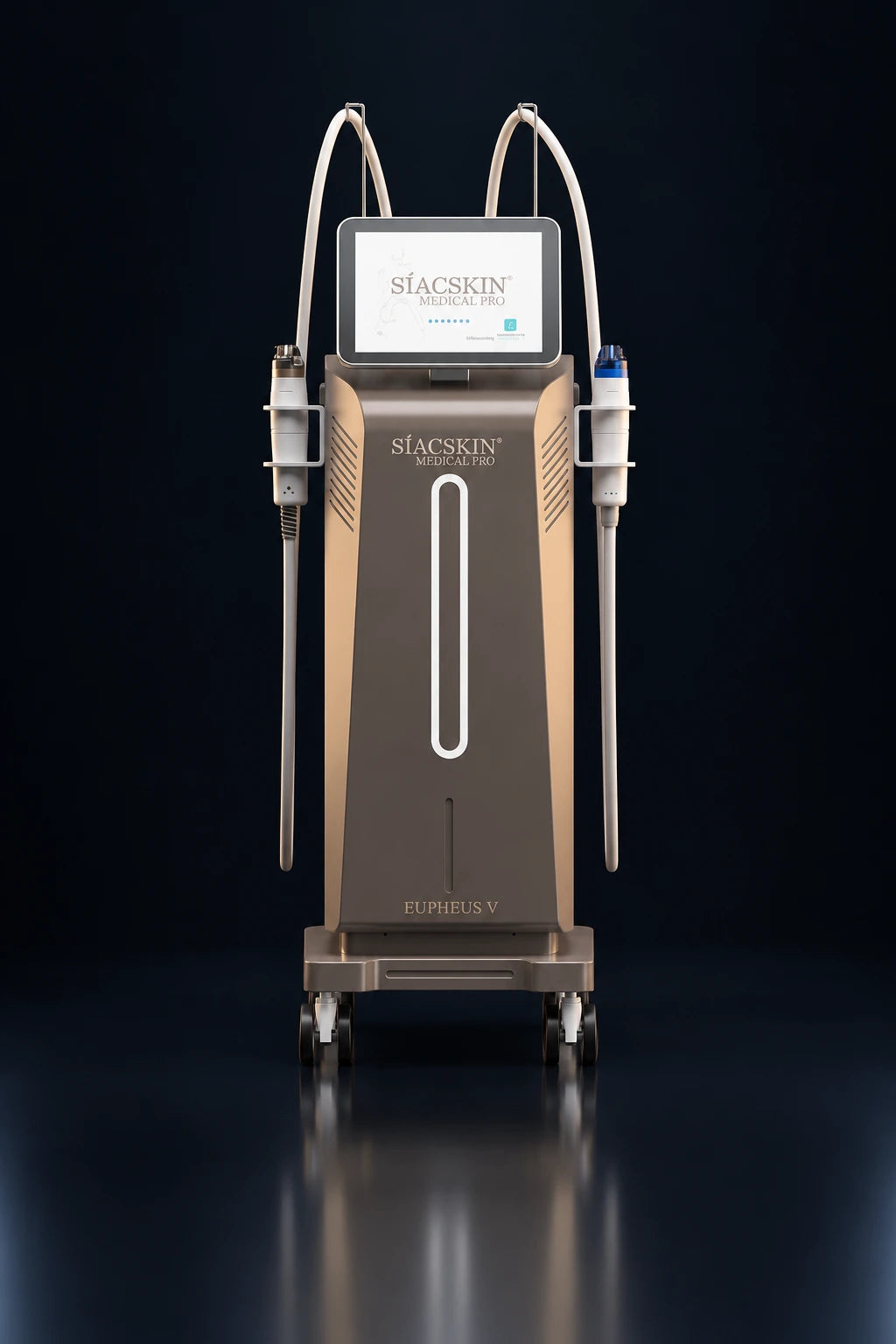
Suitable options are the TULIX at 1550 nm, which stimulates collagen formation in the dermis, and RF microneedling with a very shallow needle depth. On the EUPHEUS the depth can be set in 0.1 mm steps, which is necessary for the thin skin of the eye area. The improvement is usually visible, but limited.
Can thin skin under the eyes be made firmer with a laser or RF microneedling?
Yes, both fractional lasers and RF microneedling can make thin skin under the eyes firmer and denser through new collagen. Both create controlled micro-injuries to which the skin responds with regeneration. The result builds up over weeks to months. Fine crepey lines become smoother and visible vessels are less noticeable. Cautious settings are important, because the skin there is only a fraction as thick as on the cheek.
On the EUPHEUS you set the needle depth in 0.1 mm steps, according to SIACSKIN from the delicate eye area to scars on the body. At 1550 nm the TULIX reaches the dermis without removing the surface, which keeps downtime low.
Tear trough and shadows under the eyes: what can a device do and what can it not do?
A device can firm and smooth the skin over the tear trough, but it cannot fill a deep groove. The tear trough is a hollow between the lower lid and the cheek that becomes more pronounced with age through volume loss and sinking tissue. The shadow comes from light and shape, not from colour. Mild grooves often look softer after the skin has been tightened, while pronounced grooves need medical procedures that replace volume.
For tightening the skin, RF microneedling with the EUPHEUS at a shallow needle depth and the TULIX at 1550 nm are suitable. An honest consultation clarifies beforehand how much of the shadow comes from skin quality and how much from volume.
Treating eye bags without surgery: what can radiofrequency do and where are its limits?
Radiofrequency can tighten mild eye bags somewhat, but it does not remove true fat pads under the eyes. Eye bags develop when the connective tissue gives way and fat from the eye socket pushes forward. Loose skin above them can be firmed by the heat in the dermis, so small bags are less noticeable. Morning puffiness from water retention, on the other hand, is not a case for a device. Pronounced fat pads are a matter for a medical eyelid correction.
The EUPHEUS firms the skin of this zone with a very shallow needle depth adjustable in 0.1 mm steps. For gentle tightening without any puncture, the EUPHEUS V offers a non-invasive 49-pin tip for face and body that works only with radiofrequency heat and causes no downtime.
How many sessions are needed for dark circles and at what intervals?
For dark circles, 3 to 5 sessions at intervals of 4 to 6 weeks are usually common. Pigment-related circles often brighten visibly after the first sessions, while with thin skin and visible vessels, collagen build-up needs more time. The final result usually shows only 2 to 3 months after the last session. The exact number depends on the cause, the severity and the skin type and is not a fixed commitment.
With the TULIX the eye area is treated in several mild sessions, and the same applies to RF microneedling with a shallow needle depth on the EUPHEUS. An annual refresher can make sense, because skin ageing and sun keep acting.
How long is the downtime after a laser treatment under the eyes?
After a non-ablative fractional laser under the eyes, the skin is usually red and slightly swollen for 1 to 3 days. In the eye area the swelling is often stronger than elsewhere on the face, because the tissue there is loose. A fine grid pattern or slight flaking can remain visible for a few days and can usually be covered with make-up. After an ablative CO2 laser, the downtime is considerably longer.
The TULIX does not remove the skin surface and therefore keeps downtime low. After RF microneedling with the EUPHEUS, small puncture points and redness for 1 to 3 days are usual. Cooling and consistent sun protection support healing.
Does a laser treatment under the eyes hurt, and how is the skin cooled?
A laser treatment under the eyes is mostly described as a warm tingling or brief pricking sensation and is well tolerated. The skin there is sensitive, which is why many studios work with a numbing cream and with cooling. The eyes themselves are protected by suitable laser eye shields. After the treatment, cooling calms redness and swelling.
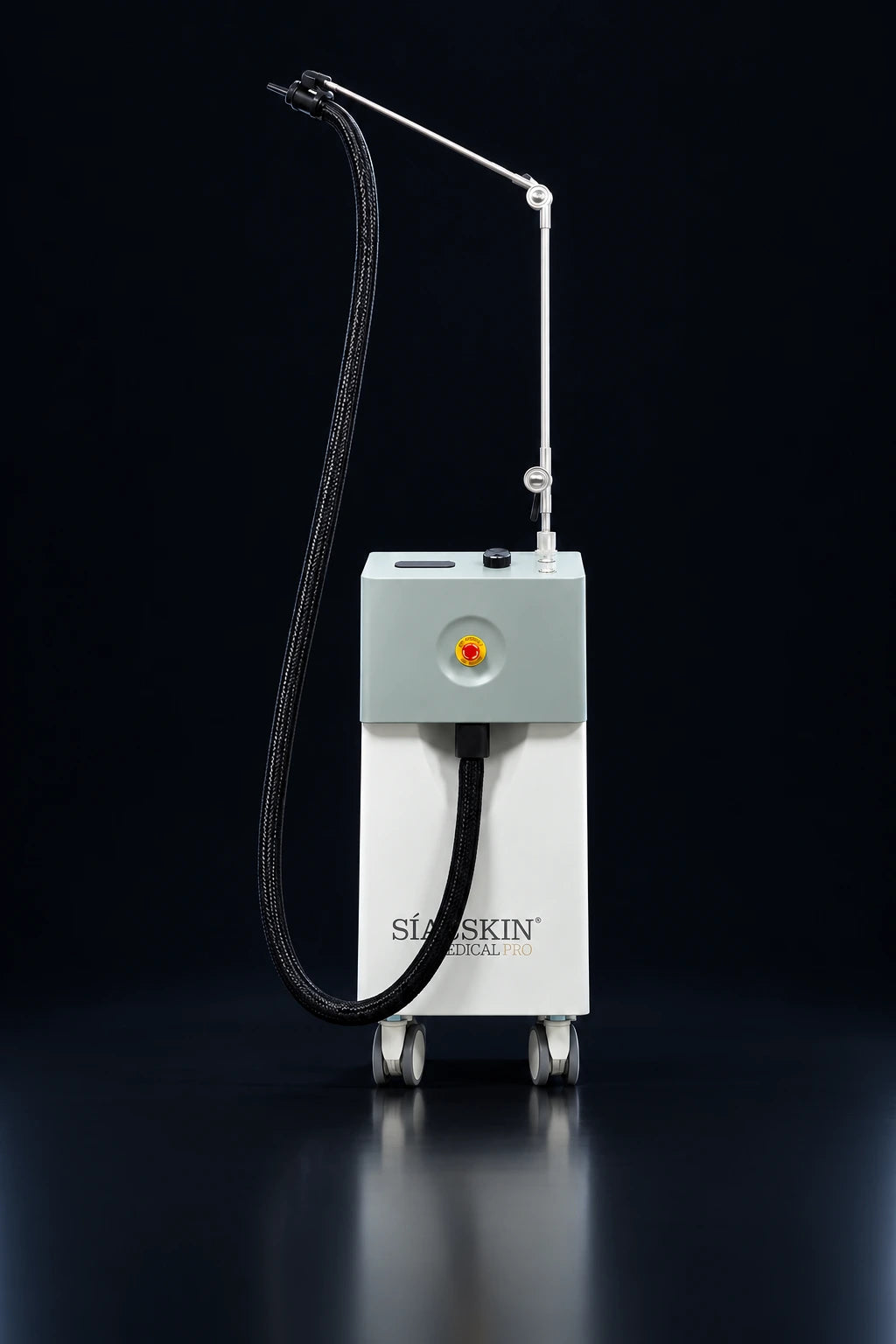
The KYROMASTER cools with cold air down to minus 30 °C before, during and after the treatment and works without contact, so the handpiece and the view of the zone stay free. On the TULIX, motion tracking and an infrared thermal sensor in the handpiece prevent double treatment and overheating, which matters especially in this sensitive zone.
Dark circles on dark skin: why are they more common and how are they treated safely?
In darker skin types, pigment-related dark circles are more common, because the skin produces more melanin and reacts to irritation with pigment more quickly. That is exactly what makes treatment delicate: too much heat can trigger new dark spots. A cautious approach is safe, using non-ablative methods, low energy, more time between sessions and a test spot beforehand.
The TULIX is designed as a non-ablative fractional laser for all skin types, and its cloud software offers a protocol library by Fitzpatrick type. Ablative lasers and broad-spectrum light devices are not a good choice for dark skin in this zone. Strict sun protection before and after the treatment is part of it.
Do eye creams, more sleep and cooling help against dark circles, or is a treatment needed?
Sleep, cooling and eye creams mainly ease temporary puffiness and tired shadows, while hereditary or pigmented dark circles hardly change. Cooling makes vessels narrow briefly, caffeine can reduce puffiness, and vitamin C can brighten slightly. Daily sun protection prevents further darkening. Anyone who has had the same circles for years will achieve little with skincare alone and is more likely to benefit from a targeted treatment.
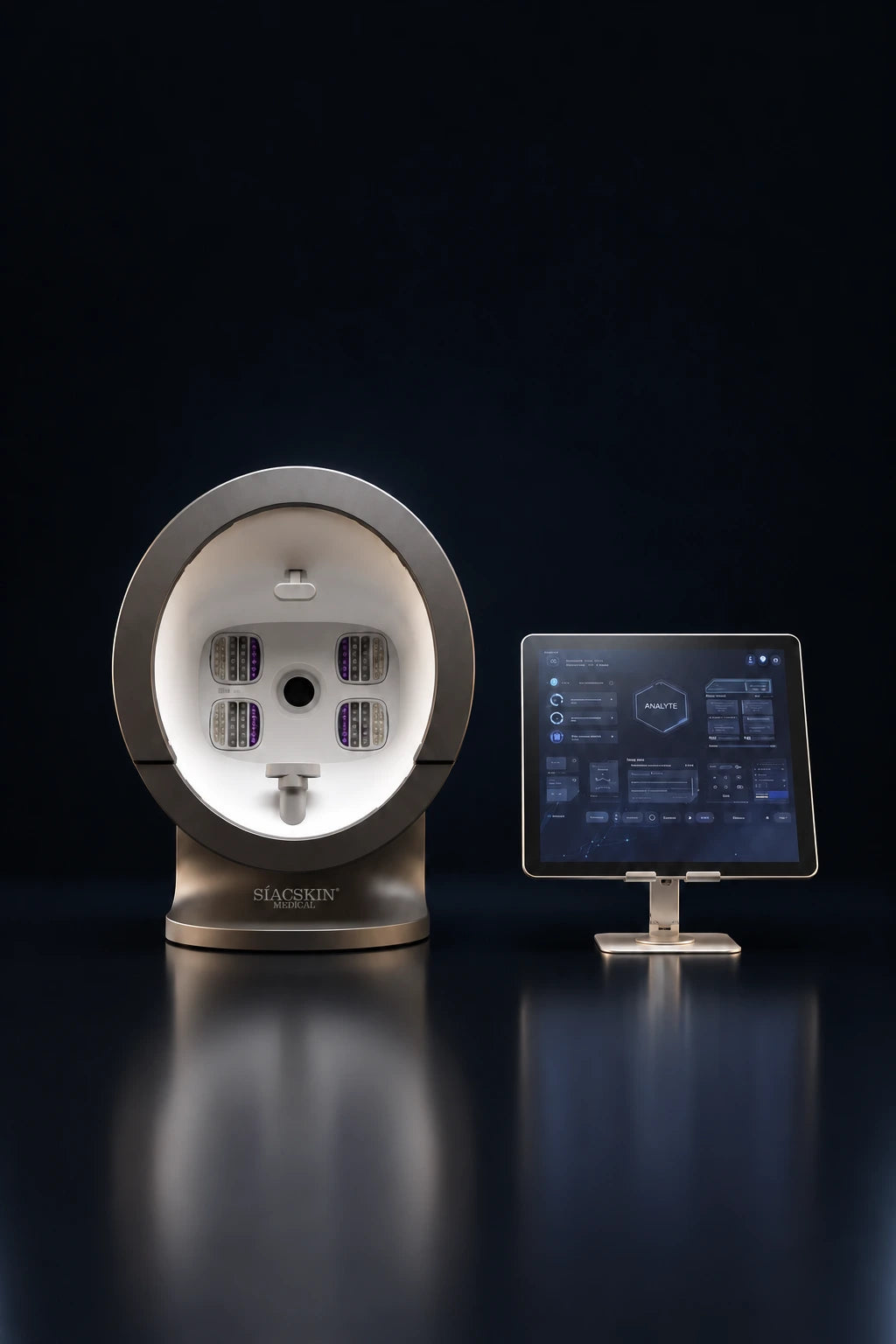
A skin analysis shows which cause is present. The Skin Analyzer Pro captures the skin under white light, UV light and polarised light and so shows whether pigment or redness predominates. This helps in choosing the right treatment.
Treating dark circles and crow's feet at the same time: which combination makes sense?
What usually makes sense is a non-ablative fractional laser as the base, supplemented for deeper crow's feet by RF microneedling or an ablative fractional CO2 laser. A non-ablative fractional laser can treat dark circles and crow's feet in the same session, because both benefit from denser skin. For more pronounced fine lines, the laser is combined alternately with RF microneedling, with at least 4 weeks between the procedures.
The TULIX covers dark circles, fine lines and pigment with one device. For deeper lines, the ablative fractional FRACO CO2 XL is the stronger option, and its CoolPeel mode offers a gentler variant with a short healing time. The EUPHEUS adds RF microneedling, whose needle depth can be finely adjusted for the thin skin of this zone.
How long does the result of a dark circle treatment last?
The result usually lasts 1 to 3 years, depending on the cause, skin type and sun protection. Newly formed collagen is retained, but natural skin ageing carries on. Pigment-related dark circles can return through UV light, rubbing the eyes or hormonal influences. A hereditary tendency remains, which is why a refresher at longer intervals can make sense.
After a series, for example with the TULIX, one refresher session per year is often enough. Daily sun protection with a high SPF, sunglasses and gentle care without rubbing contribute most to keeping the result visible for a long time.
Which devices does a studio need to treat dark circles and the eye area?
For the eye area, a studio mainly needs a non-ablative fractional laser for pigment and skin quality and an RF microneedling device with finely adjustable needle depth. This addresses most causes: brown circles, thin skin, fine lines and mild laxity. Cold air cooling noticeably increases comfort in this sensitive zone.
The TULIX lists dark circles explicitly as an application and works without consumables and without a shot limit. The EUPHEUS adds RF microneedling in 0.1 mm steps, the KYROMASTER cold air down to minus 30 °C. Who is allowed to perform which treatment is regulated differently depending on the country.